
How to Identify the Turbo on Your Truck: Part Numbers, Tags, and Engine Lookup
A turbocharger, or turbo, on a truck is a key component that moves air into the engine’s cylinders, allowing it to consume more fuel and generate more power without upgrading to a larger engine. Turbochargers are not simply for additional performance; they can also improve efficiency and help trucks perform better at high altitudes, where the air is much thinner. While many people add turbos as an aftermarket upgrade to passenger vehicles, all mainstream commercial trucks come equipped from the factory with a turbocharger.
Do you need to quickly and accurately identify the turbo on your truck? There are three main ways to do it. The easiest way is to find the data tag or plate affixed to the turbocharger. The second easiest way is to provide us with the engine serial number, or “ESN”. The last and most difficult way is to back track to the part number by using the vehicle identification number, more commonly known as VIN. Read on to learn more or contact Momentum Worx today for additional information.
Three Methods of Turbo Identification
Proper turbocharger identification helps ensure you order the correct part and maintain proper truck performance once installed. Here's a closer look at the three methods of turbo identification:
Method 1: Find the Data Tag or Plate
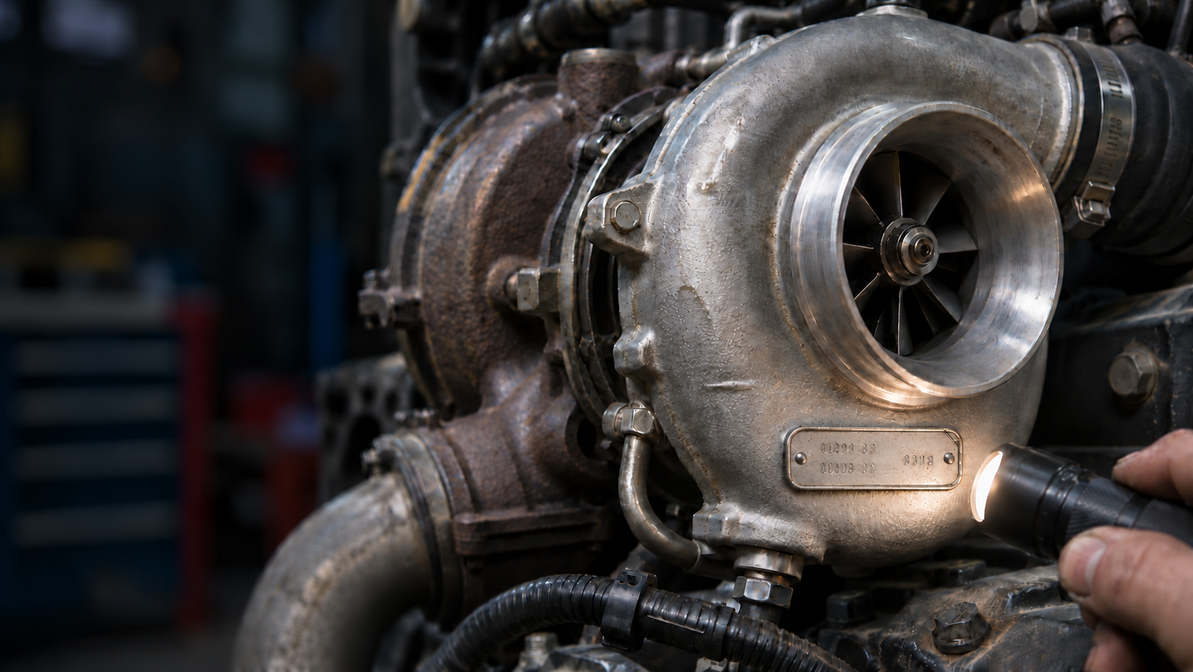
The most common and reliable method is attempting to find the data tag or plate. This is located on the compressor housing or riveted to the center section of the turbo. If you can locate the data tag or plate, you should be able to identify the manufacturer, part number, and serial number.
To find the part ID, you'll likely need to clean the part. Keep in mind that turbochargers run in demanding environments and are exposed to engine oil, grime, soot, rust, and other debris. This information is likely buried beneath that buildup. Spray the turbocharger with a degreaser, then gently scrub it with a non-abrasive brush to remove grime and debris. Wipe away any excess grime with a microfiber cloth.
Method 2: Provide the Engine Serial Number (ESN)
Engine manufacturers such as Caterpillar (CAT), Cummins, Detroit Diesel, and others assign a unique serial number to every engine they manufacture.
This serial number acts as a unique identifier for that specific engine, allowing you to look up detailed information about its original factory configuration, including the correct turbocharger part number.
Manufacturers maintain electronic parts catalogs and lookup systems that use these serial numbers to identify the correct components. Some of these systems are publicly accessible, while others are restricted to authorized dealerships and service centers.
It's important to note: If your engine has been modified or the turbocharger has been upgraded or replaced with a non-original unit, the engine serial number will typically identify the factory-specified turbocharger, not necessarily what is currently installed.
Method 3: Using The Vehicle Identification Number (VIN)
For passenger vehicles, the Vehicle Identification Number (VIN) is typically the preferred method for identifying replacement parts. Manufacturers such as Ford, GM, Toyota, and others use VIN-based parts catalogs to determine which components were originally installed on a vehicle.
However, VIN-based identification is not always reliable for commercial trucks.
Unlike passenger vehicles, heavy-duty commercial trucks are more likely to undergo engine swaps, repowers, and other major drivetrain modifications throughout their service life. It's not uncommon for a truck to have an entirely different engine than the one it originally left the factory with.
The VIN should only be used as a last resort, and only when you are 100% certain that the truck still has its original factory-installed engine and turbocharger. Even then, VIN-based identification should be verified whenever possible to avoid ordering incorrect parts.
Important: Do NOT Identify Your Turbo by the Housing Part Number
One of the most common mistakes when identifying a turbocharger is relying on the numbers cast into the exhaust housing or compressor cover.
These numbers are NOT specific to the complete turbocharger assembly.
Manufacturers often use the same exhaust housings and compressor covers across multiple turbocharger models and configurations. As a result, the casting number you find on the housing may be shared by several completely different turbochargers.
For accurate identification, you should always reference the turbocharger's identification tag or assembly part number, rather than the casting numbers on individual components.
How to Find Turbo Part Number
The easiest, fastest, and most reliable way to find the turbo part number is to look for the identification plate or stamped numbers on the compressor housing. Here's a step-by-step guide on how to do this:
- Start by turning off the truck's engine and letting it cool. This is a key safety step, as you don't want to risk burns from the exhaust side of the turbocharger component.
- In some cases, you may have to remove engine covers or air intake ducting to access the turbocharger.
- Locate the ID plate or the stamp on the turbocharger. Some manufacturers either etch or stamp the numbers right onto the flat pad of the compressor housing. However, you may need to check from different angles, depending on how the plate is oriented. If the plate or tag faces the firewall or is partially obstructed, use a flashlight and a small inspection mirror to bring the identification number into view.
- Either write down all of the numbers or take a photo of the tag with your phone's camera. Be sure to capture every digit, hyphen, and letter that's included in the identification.
Understanding Turbo Numbers: How to Read Them
While turbo numbers vary by manufacturer, identification information typically includes several digits, a hyphen, and then numbers.
For example, on Garrett and Honeywell parts, you'll typically find a six-digit number, dash, then four numbers as part of the identification. One caveat with Garrett is the the 7th place digit (XXXXXX-XXXX). This digit can be a 0, 5, or 9 and the part number is still the same turbo.
BorgWarner turbochargers are identified a bit differently, usually with an 11-digit number, or 6 digit number. BorgWarner also has some quirks; on a 6 digit part number - if it begins with a 1, its new, if it begins with a 4, its a reman. On an 11-digit part number, this indicator comes in the center 3 numbers (XXXX XXX XXXX) 988 signifies new, and 990 signifies reman.
Holset turbochargers stamp ID tags on the compressor housing or bearings that show the model family, part number, customer number, and serial number.
Be advised that there may be multiple supersessions or cross over part numbers that are the same as your turbo. Your replacement turbo may have a different part number while still being the same or equivalent turbocharger.
Identifying Turbochargers By Engines
Identifying a turbocharger based solely on the engine make and model can be a slippery slope, but with enough experience and application-specific knowledge, it can certainly be done.
For example, the Garrett 704604-5011S can be used as a stock replacement turbocharger across CAT 3406E applications. However, not every PACCAR MX-13 uses the same turbocharger. Depending on the engine's model year, horsepower rating, emissions configuration, and other factors, different turbochargers may be required.
At Momentum Worx, we've invested considerable time researching turbocharger applications, cross-referencing OEM part numbers, and identifying instances where a single turbocharger can be used across multiple engine configurations.
This research allows us to confidently group certain applications together, making it easier for customers to find and purchase the correct turbocharger without having to navigate dozens of different part numbers.
However, we never want our customers to rely on guesswork.
That's why we also offer turbocharger part number cross-referencing to verify compatibility before you purchase. Even when a turbocharger is listed as compatible with your engine, we encourage you to confirm the original part number to ensure you're getting the correct replacement for your specific application.
Common Mistakes and Look-Alike Turbos
Avoid these common pitfalls when identifying the turbo on your truck:
- Don't confuse casting numbers with ID tags: This is one of the most common mistakes made. While casting numbers can likely be cross-referenced to identify the turbocharger, they don't replace the ID tag.
- Don't rely simply on look: Many drivers assume turbocharger models based on look, frame size, and more. However, turbochargers can share similar frame sizes but feature different internal components. Some of these "invisible differences" include compressor wheel blade count, wheel dimensions, A/R, and wastegate actuator spring measurements.
- Look for any aftermarket upgrades: Aftermarket upgrades are one of the most common reasons behind misidentified turbochargers. It underscores the importance of proper verification.
The wrong turbocharger can undo many of the key benefits that these components are known for. Common problems of improper fitment include lag, excessive exhaust temperatures, over-boosting, or even complete engine failure.
Turbocharger Identification FAQs
Can I look up my turbo using my truck's year, make, and model?
Yes, but because production changes and engine options vary by truck, this isn't always the most reliable method. Always look for the ID tag or plate first before trying other ways to identify a turbocharger.
What do I do if the data tag on my turbo is missing?
If the data tag on your turbocharger is missing, move on to the other main methods of identifying this component - ESN or VIN verification.
Do numbers stamped on the exhaust housing help identify the turbo?
Yes, stamped numbers on the exhaust housing can help, but they usually identify the housing part number or a specific A/R size, not the complete turbocharger assembly. Because of this, you should cross-reference these numbers to identify the correct turbocharger.
What's the difference between an OEM turbo and buying from a name brand directly?
While you'll likely receive the same physical part, key differences are usually in branding and packaging, pricing, and warranty support.
What is the ESN, and why is it important?
ESN stands for "engine serial number." It's the single most helpful data point if the turbo tag ID is missing or too damaged to read because truck manufacturers document every component attached to a vehicle's engine from the second it exits the assembly line. Based on this data, you should be able to identify the turbo on the truck.
Still can’t identify your turbo? Fill out our What Turbo Do I Need form or call us at (215) 237-9672 and we’ll help you find the right match.
Recent Posts
-

How to Identify the Turbo on Your Truck: Part Numbers, Tags, and Engine Lookup
A turbocharger, or turbo, on a truck is a key component that moves air into the engine’s cylinders, …16th Nov 2026 -
Cummins ISX Turbo vs. Actuator Failure: How to Tell Which One Is Bad
Is your Cummins ISX turbo failing, or is it just the VGT actuator? Here's how to tell the difference …27th Oct 2026 -

CAT C15 / CAT 3406E | S430SX vs. S410SX Turbo— What You Need to Know
S430SX vs. S410SX — What You Need to Know If you're searching for an S430SX turbocharger, it's impor …18th Feb 2026